Any preferred art medium like oils or acrylics and a con as or two same size canvas for panel painting.
Step 1: Break the Story into Visual Elements:
Before painting, select a story
My story:
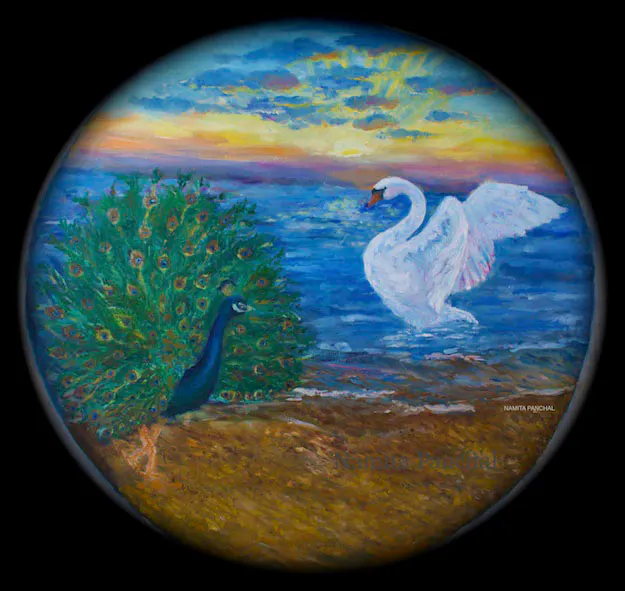
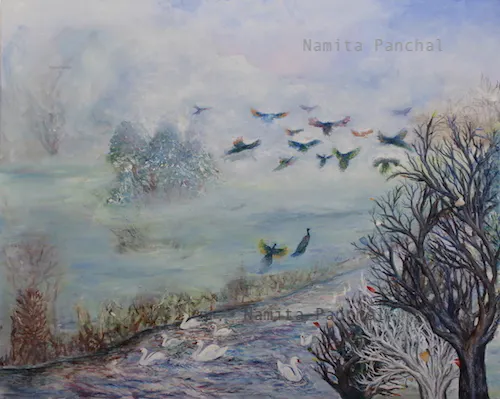
A swan stands at the edge of an ocean, ready to fly toward the unknown. A peacock, radiant and joyful, tries to hold it back—celebrating comfort and beauty in the present moment. But the swan chooses the harder path. On the other side of the ocean, it discovers a serene, heavenly land filled with other swans. A quiet reminder: the difficult path often leads to the most sublime destinations.
Step 2: Plan Composition for Story Flow
Plan the composition according to the story either build a single storytelling landscape or a panel sequence that unfolds like a visual poem.
I have illustrated my story in two panels
Panel 1: Temptation & Choice
Peacock dancing (comfort, beauty, distraction) And Swan watching (inner conflict). There is a ocean visible ahead (unknown journey)
Panel 2: Journey Fulfilled
Swan reaching a peaceful land Where there are other swans (belonging, reward), Calm, divine atmosphere
In my first painting peacock is placed in foreground (vibrant, eye-catching), Swan slightly turned toward ocean and the ocean stretching into distance. This creates tension: stay or go?
On the other hand the second painting is calm and balanced. This creates peace and completion.
Use diagonal flow → from peacock to horizon
Step 3: Paint the Base Layers
Choose your preferred art medium and Start simple—no details yet.
Paint sky gradient (soft sunrise tones)
Add rough land shapes
Block trees and path with basic colors
👉 Focus on big shapes first, not details.
Step 5: Build Depth (Make the Story Feel Real)
Divide your painting into:
Foreground → darker, more detailed
Midground → softer, less contrast
Background → light, hazy
Create mood and time
Mood = story emotion.
Dawn light → new beginning
Mist/fog → mystery
Warm light on temple → hope or discovery
👉 Keep lighting consistent, this ties the whole story together.
Now enhance storytelling by adding atmosphere and emotion. Characters are the emotion carriers
Step 8: Connect Both Panels Visually
Even though they are separate, they should feel like one story.
Use similar color undertones
Maintain consistent horizon level
Repeat subtle elements (sky tones, water texture)
👉 This creates continuity.
Hence, the painting is ready.
My paintings depicts story moral “Sometimes the most beautiful destinations lie beyond the path we hesitate to take.”